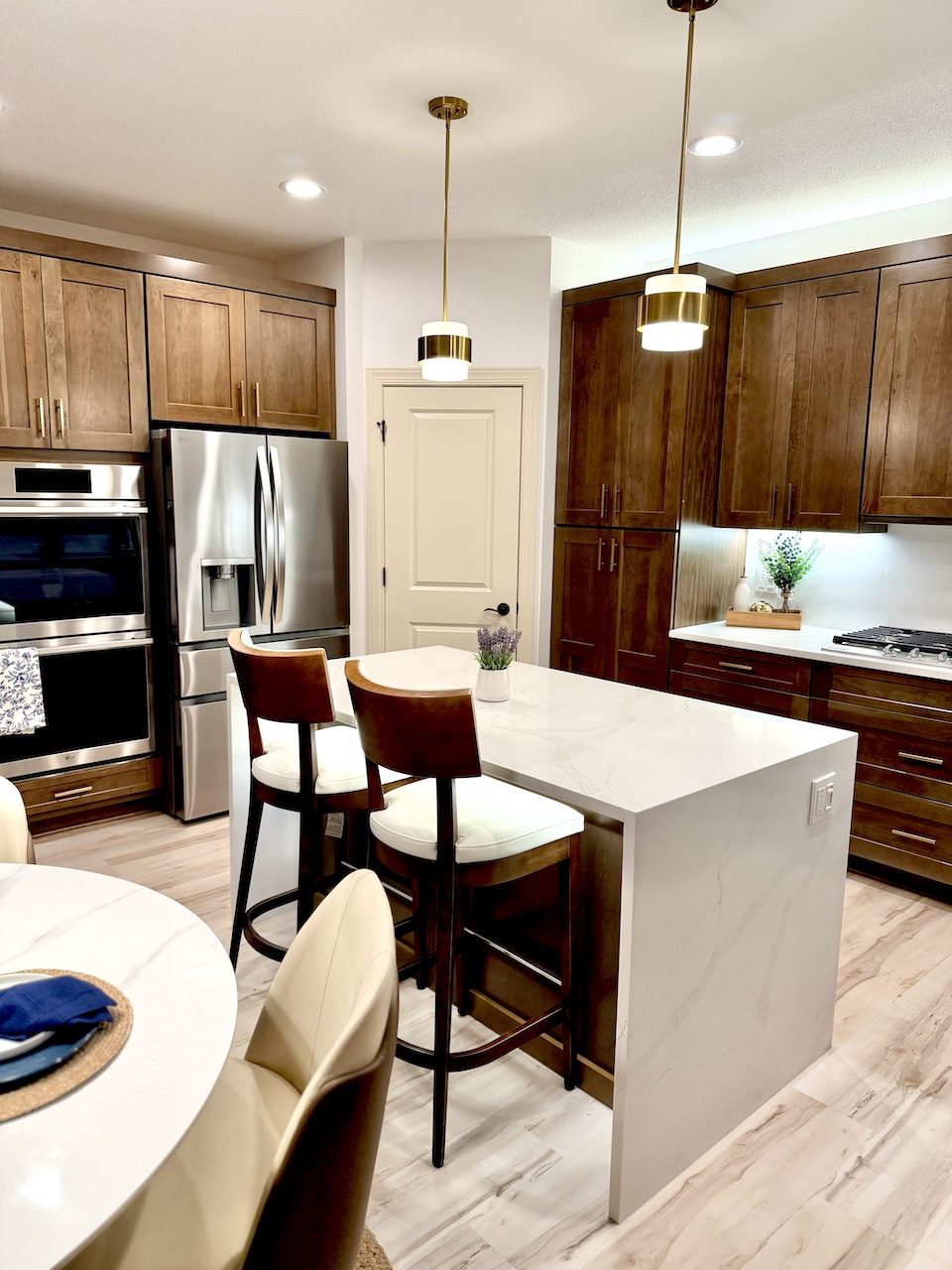
A waterfall edge carries the slab down the side of an island to the floor. It costs more because it uses more slab and a precise mitered joint — and it is worth it on an island whose end faces the room.
A waterfall edge is a countertop that continues over the end of an island and straight down to the floor, so the stone reads as one folded piece. It costs more than a standard island because the vertical panel consumes extra slab, the corner is a mitered joint that has to be fabricated and fitted precisely, and the grain has to run continuously across the fold to look right. It is worth it when the end of the island faces the room — the waterfall becomes the piece people see first — and least worth it on an island whose ends are tucked against a wall or covered by seating.
What you are paying for
- Material. The side panel is a second piece of slab — often a full slab's worth for a long island, and two panels if both ends waterfall.
- The mitered joint. Both pieces are cut at 45 degrees and joined so the face appears continuous. It is exacting work, and the thicker 3 cm stone looks best at the fold.
- Grain matching. On a veined quartz or quartzite the veins should flow over the edge; that means laying out the pieces from one slab, or book-matching two.
- Installation. The panel is set plumb to the floor and supported, with the joint finished on site.
Alternatives that read similar for less
- A mitered build-up edge — the same 45-degree fold, but only a few inches deep, giving the island a thick, monolithic edge without the full panel.
- A single waterfall on the visible end only.
- A contrasting panel or wood end on the island with the slab kept to the top.
See real waterfall islands from our own projects in the inspiration gallery, filtered to the Waterfall Edge tag, and ask for the waterfall as an option line on your quote so you can decide with the number in front of you.